Can you eat oysters in summer?
Yes. There is no best season for oysters: they are very good in summer and very good in winter. If people long avoided serving them in the warm months, it was for two very real reasons, freshness and taste, and each now has its answer.
The "R months": where does the rule come from?
The rule says to eat oysters only in months whose name contains an "r": September to April. May, June, July and August, the months without an "r", are the warm ones. The habit is very old: on an island in Georgia, in the United States, archaeologists have shown that oysters were already harvested mostly from autumn to spring more than 4,000 years ago.
First reason: freshness
Until the 19th century there was no refrigerated transport. Before the railway, oysters reached the great capitals by horse-drawn cart, from Cancale to Paris for instance. In winter they coped very well with several days on the road at ambient temperature. In summer, in the heat, the journey became impossible: oysters were then eaten only near the sea.
Second reason: milkiness
Summer is the oyster's spawning season. As the water warms, the oyster fills with gametes, male or female: it turns "milky". Its taste becomes harsher and more bitter, and these are generally not the oysters people like best.
What has changed: transport
Chilled transport is now controlled from end to end. The oyster travels alive. It does not need the cold of fish, 0 to 2 °C on ice: it wants a steady coolness, between 8 and 12 °C, closer to a cheese cellar. Summer or winter, it arrives in the same condition.
At home the rule is the same: keep them cool, between 5 and 15 °C, flat and away from light.
What has changed: the triploid oyster, the "four-season" oyster
Most oyster farmers now grow a triploid oyster. It has exactly the same genes as a classic oyster, with nothing added and nothing modified: it simply carries three sets of them instead of two. So it is not a GMO. Nature sometimes produces triploids by itself, and the same principle gives us bananas and seedless watermelons.
This oyster does not reproduce. It therefore never turns milky and keeps all its energy for its flesh, summer and winter alike: hence the name four-season oyster. It is born in a hatchery, where breeding takes place in a controlled environment, then grows at sea like any other.
So which oyster, and when?
In summer, it is best to avoid so-called natural, or diploid, oysters: they are very likely to be milky. With triploids there is no issue, in July as in December.
And in September? It is the first "r" month: the spawning season ends and natural oysters gradually regain their flesh. Triploids never stopped being good.
And Ostra Regal?
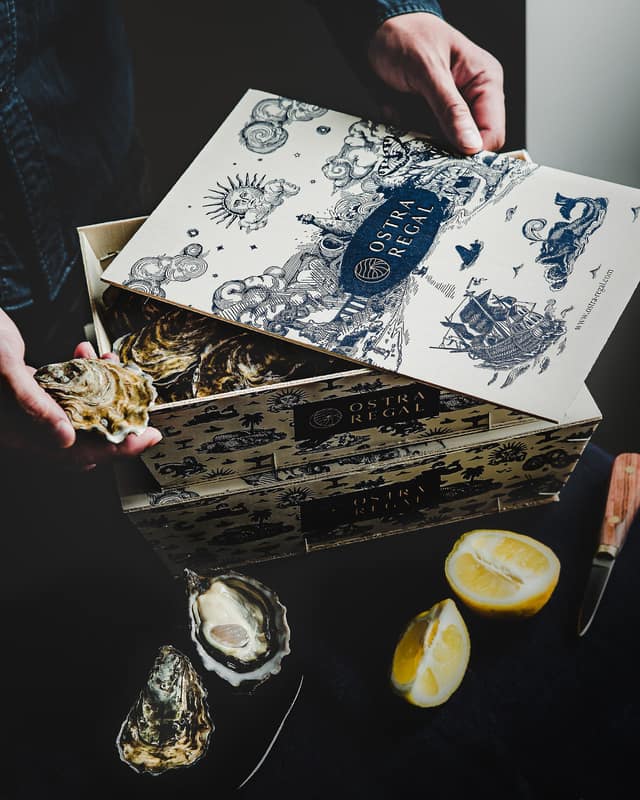
Ostra Regal is a triploid oyster. It never turns milky and can be enjoyed all year round, with the same firm flesh in midsummer as in the depths of winter. Each oyster is selected by hand, for consistent quality from one month to the next.
The role of tides
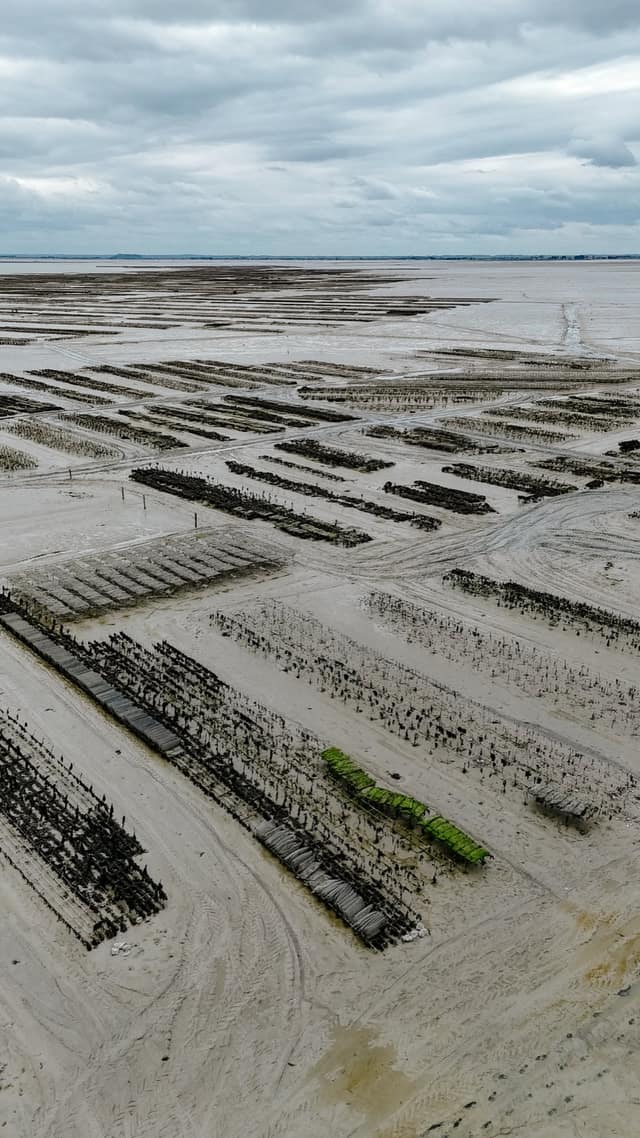
On our Irish beds (Dundrum Bay, Bannow Bay), the oyster lives to the rhythm of strong tides. Alternating immersion and exposure strengthens the oyster, refines its shell and concentrates aromas — giving that firm flesh and clean iodine.